

 2025-10-09
mpweekly 6 Oct 2025
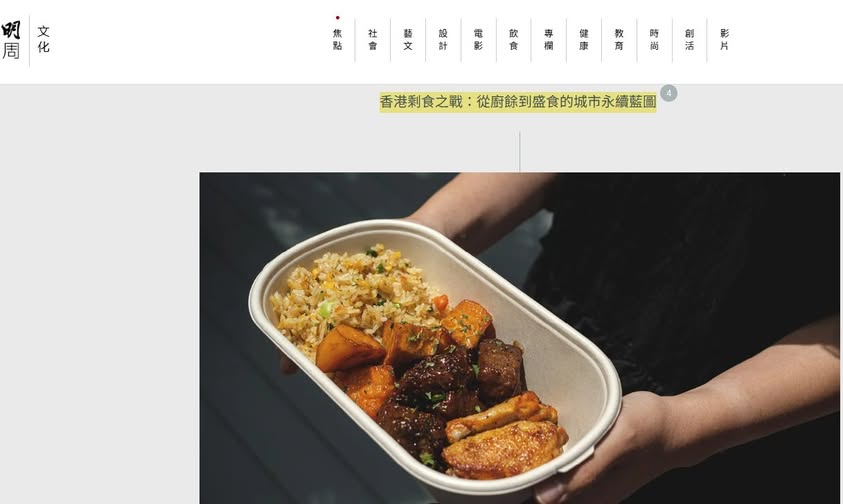
Food has a precarious existence from the time it is produced until it is consumed. Numerous variables contribute to the rejection and disposal of ingredients across the food supply chain. Food waste can be caused by a variety of factors, such as cosmetic flaws, products that are getting close to expiration and cannot be sold quickly enough, industry overproduction, or consumers' finicky tastes. These wastes are divided into two categories based on the method or state: "kitchen waste" and "leftovers." In 2023, Hong Kong's landfills received more than 3,000 tons of kitchen garbage every day, according to the Environmental Protection Department. Despite the fact that the present "3,000 tons" are typically categorized as food waste, how many of these are disregarded yet still valuable for reuse? This time, we highlight these undiscovered treasures and observe how various organizations are overcoming obstacles to prevent food waste, all the while considering ways to prevent food waste during feasts.
https://www.mpweekly.com/culture/topic/%e9%a6
Can we develop a waste-reduction culture by sorting kitchen garbage and conserving food?
Hong Kong Food Recycling Milestone
2009: The Food Sharing Scheme* was established, pioneering and promoting Hong Kong's first food recycling and sharing project by linking local groups with existing community networks to collect and distribute leftover food from markets via basic handcarts. In the same year, "Food Grace," supported by the Food Sharing Scheme, was founded as Hong Kong's first food recycling organisation, advocating waste reduction at the source and mutual help in food conservation.
2011: Several charitable organizations dedicated to food aid were established, including Feeding Hong Kong and Food Angel, to further promote food recycling.
2013: the previous Environment Bureau launched the "Food Wise Hong Kong Campaign" with initiatives like the Food Wise Charter, the Food Wise Eateries Scheme, and the "Big Waster" campaign. The 'Big Waster' mascot became a popular icon, raising public awareness of the topic of food waste collection. The concept of "leftover food can be eaten again" was introduced to the general public for the first time, and participating supermarkets, including ParknShop and Wellcome, began testing donations.
2014-2016: The significant investment from the Environment and Conservation Fund (ECF) led to the emergence of a wide variety of food waste projects, with non-profit organizations applying in many districts across Hong Kong, featuring market recycling, supermarket pickup, and bread recycling.
2017-2019: Businesses began to pay attention to their corporate image, and under the influence of CSR and ESG, they invested in food recycling and partnered with charitable organizations that focus on food relief, including near-expiry or surplus goods in their donations.
2022: Economic stress and restaurant closures reduced the sources of leftover food, while simultaneously leading to increased unemployment and rising demand from impoverished families. However, policy shifted towards supporting "food waste management" rather than "leftover food assistance," and the Environment and Conservation Fund reduced its funding for "leftover food assistance" projects. Many small and medium-sized non-profit organizations involved in related projects were forced to transform or end their "food recycling" projects.
2023-2025: Large organisations (such as Food Angel) will establish "central factory"-style kitchens, emphasising scale and efficiency, whereas small and medium-sized units (such as the People Service Centre) will focus more on community networks and education, shifting towards parent-child activities and community connections, and maintaining self-sustaining projects related to the "food waste" issue. In 2015, the "Food Sharing Scheme" changed its name to the "Food Commons Foundation" and began accepting public donations. In 2018, the food rescue community network was renamed "Food Sharing Hong Kong".
https://www.mpweekly.com/culture/%e9%a3
Should urban infrastructure projects incorporate measures to reduce food waste?
Hong Kong is moving into a new era of aging and sustainable development. Food waste is no longer merely an environmental issue; it also tests public health, grassroots support, and social resilience. Carol Kwok, project manager of the Food Commons Foundation, stated that food resource management must be elevated from a charitable level to urban infrastructure; food waste and kitchen scraps should be managed in an integrated manner, transforming food conservation into a systematic public service that is as continuous and stable as road cleaning.
Carol proposed five government strategies: increasing business participation through tax incentives, removing legal barriers through liability exemption laws, developing a dependable allocation system with public resources, encouraging participation through education and community programs, and, finally, implementing the Hong Kong Food Waste Law to lay the groundwork for an institutional foundation. This blueprint, from source to system, aims to address the current institutional gap where "discarding is cheaper than donating," allowing food waste to return to the community on a large scale, with low barriers and efficiency, becoming a long-term action that crosses policies, departments, and communities.
Her initiative also provides a new way of thinking: food waste recycling, if limited to charity, cannot withstand the dual pressures of an ageing population and social poverty; however, when integrated into long-term policy planning, it can be transformed into an urban infrastructure project that improves public health, reduces environmental burden, and strengthens community cohesion. The underlying values of "save food, less waste" go beyond charity.